

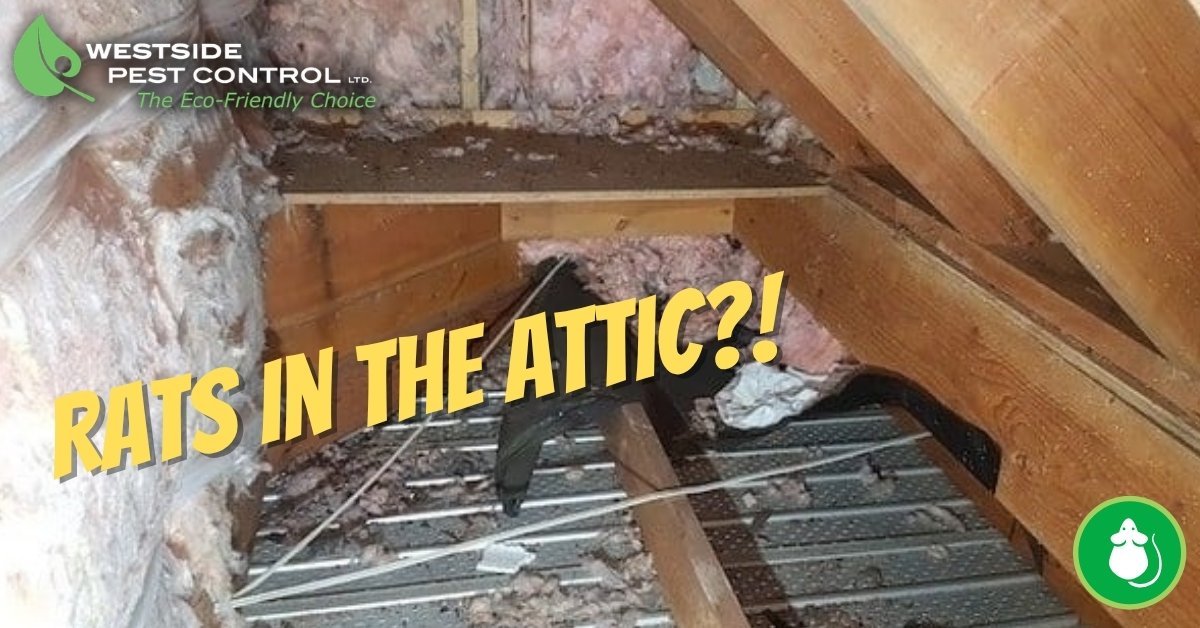
Nothing wakes you up quite like something running laps above your bedroom ceiling at 3am.
Squirrel? A very small burglar?
If it’s happening at night, our money’s on rats.
Attics give rats exactly what they want: a warm, dry spot with piles of soft insulation to nest in. In Metro Vancouver it’s usually roof rats, the climbers of the rat world. Here’s how to get them out and stop them from coming back.
TLDR: Night-time scurrying and thumping in the attic usually means rats. Trim back trees and branches touching the roof, trap along the runways in the insulation and seal the gaps at the roofline with metal. Badly soiled insulation may need replacing. Still hearing them? Call 604-559-9060.
Is it rats in the attic, or something else?
Timing is your best clue.
Squirrels are active in the daytime, so morning and late afternoon noise points to them. Rats come out after dark. Raccoons are heavier and sound more like someone moving furniture.
Other signs of rats in the attic:
- Droppings on top of the insulation, around 10 to 20 mm long
- Tunnels and flattened runways through the insulation
- Chewed wiring, wood or ductwork
- Nests of shredded insulation near the eaves

Dealing with mice or squirrels instead? Our post on rodents in your attic covers those too.
How rats get into your attic
Roof rats are excellent climbers. They’ll run up a tree or along a hydro line, then look for a gap about the size of a quarter.
The spots we check first:
- Gaps at the eaves and soffits
- Roof vents with damaged or missing screens
- Gaps around plumbing stacks and other roof penetrations
- The spots where two rooflines meet, like dormers
- Branches that touch or hang over the roof
For the full rundown on this species, read our guide to roof rats in Metro Vancouver.
How to get rid of rats in the attic
1. Cut off the highways
Trim trees and shrubs so branches are at least a couple of metres from the roof. Rats are happy to jump, so a branch hanging over the gutter is basically a bridge.
2. Trap along the runways
Look for the paths rats have flattened through the insulation, usually along the edges near the eaves and beside the trusses. Set snap traps right on those runways.
Bait them with peanut butter and leave them unset for a few days so the rats get used to them. Then set them and check every day or two.
Warning: In the attic, only step on the joists. Step between them and your foot will come through the ceiling below. Wear a dust mask and gloves too, since you’ll be close to droppings and fibreglass.
3. Find where they’re getting in
At dusk, go outside and watch the roofline for a while. Roof rats often leave the attic to feed shortly after dark, and you may spot the exact gap they use.
4. Seal the roofline with metal
Once trapping has cleared them out, close up every gap. Screen roof vents with heavy metal mesh and cover soffit gaps with sheet metal or hardware cloth.

Timing matters here. Seal the main entry while rats are still inside and they’ll chew their way out somewhere else, sometimes into your ceiling or walls. A one-way door on the last hole lets them out without letting them back in.
5. Deal with the insulation
Rats leave droppings and urine all over the attic, and insulation soaks it up. Small patches can be cleaned carefully. A heavily soiled attic usually needs the old insulation removed and the space sanitized before new insulation goes in.

We handle that too. Here’s more on our attic and crawlspace insulation services.
Rats in your attic right now? Our technicians trap them out and seal your roofline with materials rats can’t chew through. Book a rat control inspection or call 604-559-9060.
What about rat poison in the attic?
We’d skip it. We’re rodenticide-free for good reason.
A poisoned rat often dies deep in the insulation or down inside a wall where you can’t reach it. The smell drifts straight down into the rooms below. Rats that wander outside after eating poison can also end up eaten by owls and pets.
Out of ideas?
Attic rat problems tend to come back when the roofline isn’t fully sealed. One missed gap is all it takes.
Our technicians trap out the rats and do a proper entry point exclusion. Call 604-559-9060 or get in touch online.
Westside pro tip
Check your attic once in late summer, before the fall rush. Rats start moving indoors when the weather turns, and fresh droppings on top of the insulation in September are much easier to deal with than a nest in January.
See related: How to get rid of rats in the ceiling | How to get rid of rats in the walls | How to get rid of rats permanently
FAQs
How do I know if it’s rats or squirrels in my attic?
Listen for when it happens. Squirrels are busy in the morning and late afternoon, while rats are active at night. Droppings help too, since squirrel droppings are rounder and rat droppings are longer with blunt or pointed ends.
Do I need to replace the insulation after rats?
Not always. If there are only a few droppings in one area, careful spot cleaning can be enough. If the insulation is flattened, tunnelled and soaked with urine, replacing it is the better option for smell and hygiene.
Can rats get from the attic into the walls?
Yes. Wall cavities usually open up into the attic at the top, so rats can climb down inside them. That’s why you’ll sometimes hear scratching in the walls of upstairs rooms. Here’s how to deal with rats in the walls.